Learning Outcomes:
i. Describe Alfred Wallace's independent discovery of natural selection and its similarities to Charles Darwin's theory.
ii. Explain how Wallace's findings motivated Darwin to publish his own work on evolution.
iii. Analyze the importance of collaboration and scientific exchange in the development of knowledge.
Introduction:
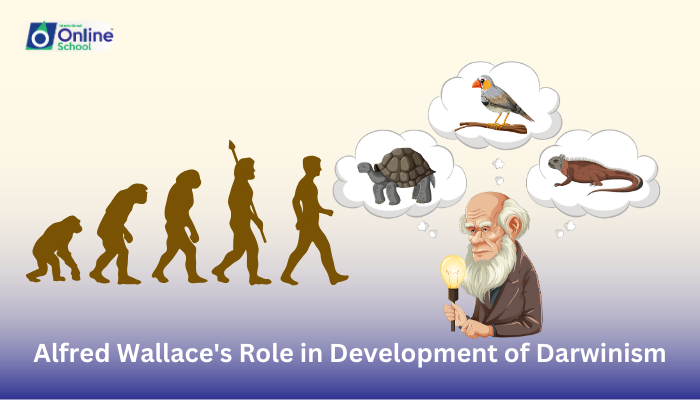
Imagine two explorers, venturing into uncharted territories on opposite sides of the globe. One, Charles Darwin, sails the vast oceans, collecting evidence on the Galapagos Islands. The other, Alfred Wallace, treks through the lush jungles of the Amazon, observing the incredible diversity of life. Both men, driven by curiosity and a thirst for understanding, stumbled upon a revolutionary idea: the principle of natural selection.
This lesson shines a spotlight on Alfred Wallace, often overshadowed by Darwin's fame. We'll explore his crucial role in shaping the theory of evolution and understand how their collaboration sparked a scientific revolution.
i. Wallace in the Amazon: An Independent Discovery:
While Darwin meticulously gathered data on the Galapagos finches, Wallace, in the Amazon rainforest, was witnessing a similar phenomenon. He observed an astonishing variety of plants and animals, each uniquely adapted to their environment. He noticed how certain traits, like camouflage or efficient hunting skills, gave some individuals an edge in the struggle for survival. This advantage, he realized, could be passed on to offspring, gradually shaping the population over generations.
Wallace, unaware of Darwin's work, independently arrived at the concept of natural selection. He penned his ideas in a now-famous essay, "On the Tendency of Varieties to Depart Indefinitely from the Original Type," and sent it to Darwin in 1858.
ii. A Race Against Time:
Darwin, who had been sitting on his own research for over two decades, was initially shocked by Wallace's independent discovery. However, instead of jealously guarding his work, he recognized the importance of sharing their findings with the world. He encouraged Wallace to publish his essay, and with renewed urgency, prepared his own book, "On the Origin of Species," for publication in 1859.
This joint effort marked a pivotal moment in scientific history. Darwin and Wallace's work, though independently conceived, presented a compelling and unified explanation for the diversity of life on Earth.
iii. Collaboration and the Triumph of Science:
The story of Darwin and Wallace is a testament to the power of collaboration and scientific exchange. Their willingness to share their findings, despite the potential for personal gain, accelerated the pace of scientific discovery and revolutionized our understanding of the natural world.
Their collaboration serves as a valuable lesson: scientific progress rarely occurs in isolation. By sharing ideas, questioning assumptions, and building upon each other's work, scientists can illuminate the mysteries of the universe, just as Darwin and Wallace did with the theory of evolution.
Alfred Wallace, though often overshadowed, played a crucial role in shaping the theory of natural selection. His independent discovery and collaboration with Darwin demonstrate the importance of open communication and shared knowledge in scientific progress. The story of Darwin and Wallace serves as a beacon of inspiration for future generations of scientists, reminding us that collaboration and open exchange are vital ingredients in the pursuit of understanding the world around us.
